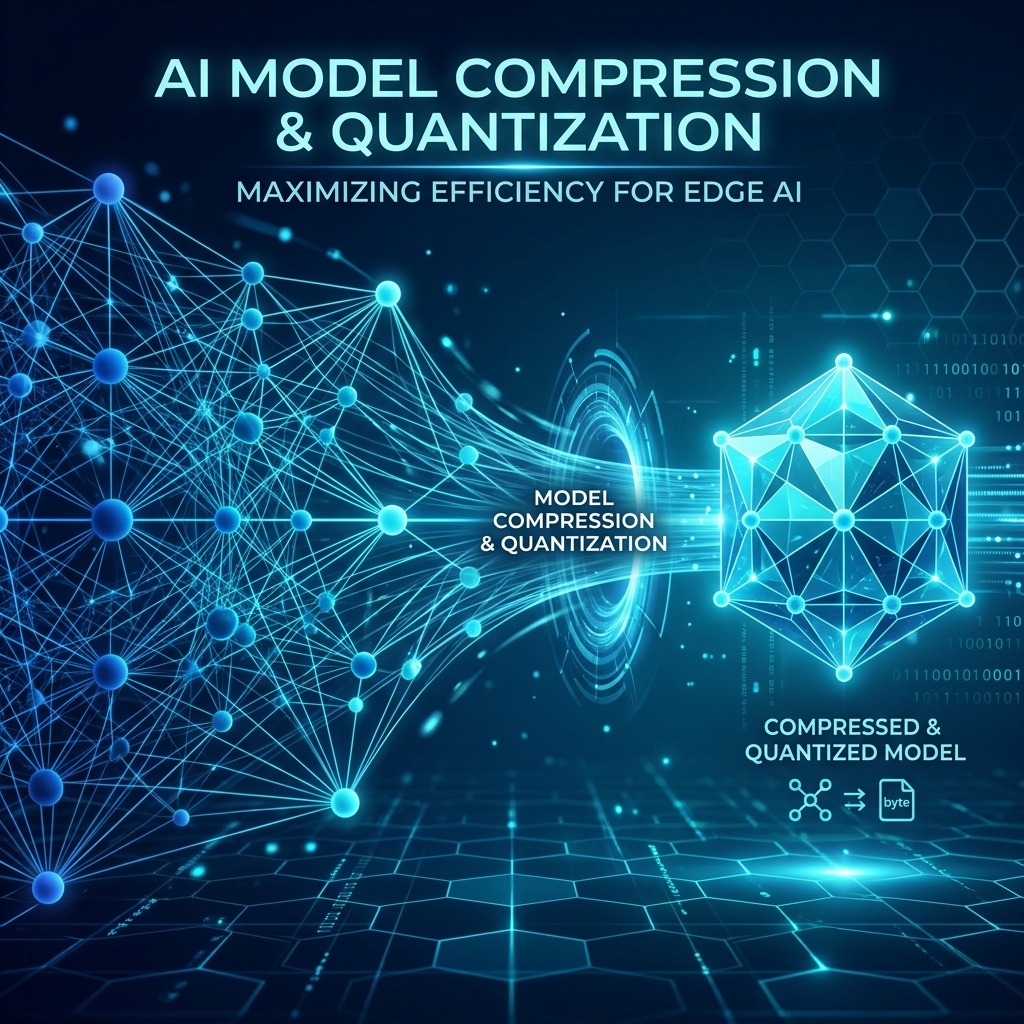
Google's TurboQuant Achieves 6x KV Cache Compression With Zero Accuracy Loss
Google Research has unveiled TurboQuant, a revolutionary AI compression algorithm that could fundamentally change how large language models are deployed and served at scale.
The core innovation tackles the notorious "Key-Value (KV) cache bottleneck" — a memory-intensive component that grows linearly with context window length. As models like Gemini and GPT handle longer contexts (100K+ tokens), KV cache can consume tens of gigabytes of GPU memory, making deployment prohibitively expensive.
TurboQuant achieves at least a 6x reduction in KV cache memory requirements while maintaining what Google calls "perfect" benchmark performance across question answering, code generation, and summarization tasks.
On NVIDIA H100 GPUs, 4-bit TurboQuant delivers up to an 8x performance boost in computing attention logits, with advantages scaling further for longer contexts.
What makes TurboQuant particularly practical is that it requires no retraining or fine-tuning. It operates as a "data-oblivious" method, meaning it doesn't need dataset-specific calibration. Organizations can apply it to existing transformer models and immediately benefit from reduced memory footprint.
The algorithm works by treating quantization as a geometric problem in high-dimensional space. It uses a two-stage process: first, geometric preconditioning rotates input vectors to make them easier to compress; then optimal scalar quantizers are applied, complemented by the Quantized Johnson-Lindenstrauss (QJL) transform to correct for bias.
This development is significant for the democratization of AI — enabling powerful models to run on smaller GPU configurations and potentially even consumer hardware. Combined with Google's related PolarQuant research, these advances signal a new era of efficient AI inference.